
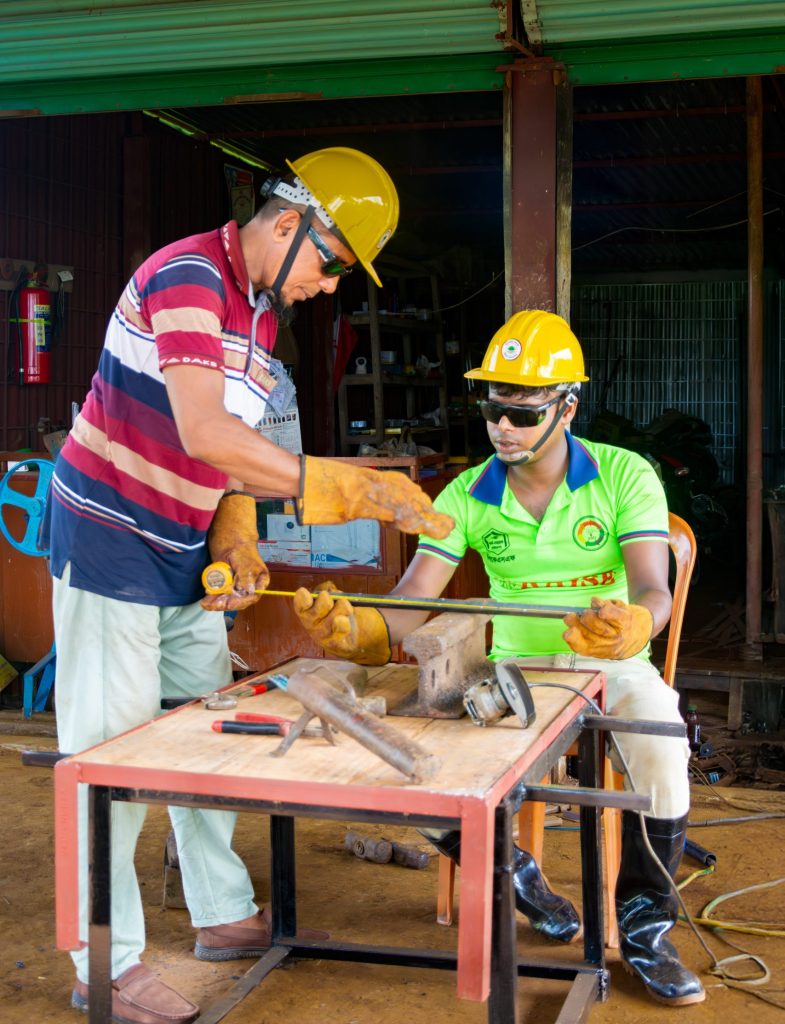
Just three and a half years ago, Md Farid Uddin was an unemployed young man with no clear direction in life. Today, the 26-year-old from Khetlal upazila of Joypurhat district runs his own welding business, earning around BDT 35,000 a month. His income has enabled him to build a semi-pucca two-room house for his family and provide them with a better life. Once worried about finding a job, Farid now dreams of expanding his business and creating employment opportunities for other young people.
Farid’s success did not come overnight. It was built through years of hard work, determination, and the right opportunity. Like thousands of young people across Bangladesh, he could easily have remained unemployed after dropping out of school. Instead, one opportunity changed the course of his life.
Farid grew up in a poor family where every day was a struggle to make ends meet. Financial hardship forced him to leave school before completing his studies, leaving him without a degree or employable skills. His father, the family’s only earning member, struggled to support the household, and financial pressure often created tension at home. Yet Farid’s mother, Farida Begum, never gave up hope that her son would one day build a better future.
That opportunity came when Farida Begum attended an awareness event organized by Ahead Social Organization (ASO), a Partner Organization of PKSF. There, she learned about the PKSF’s RAISE project and encouraged Farid to visit the ASO office. After learning about different training opportunities, Farid chose welding and, on 1 January 2023, began his apprenticeship under Master Craftsperson Md Faruk at Faruk Engineering Workshop.
As Farid’s ustad (mentor), Faruk taught him not only welding but also the values of hard work, discipline, honesty, and responsibility. Through the RAISE project, Farid also received life skills training, which helped him become more confident, overcome self-doubt, and prepare for the workplace. After completing six months of apprenticeship, he was offered a job at Faruk Engineering Workshop with a daily wage of BDT 450. The experience gave him the confidence to dream bigger.
Farid’s entrepreneurial journey began when he received a BDT 100,000 loan through the RAISE project. He purchased welding equipment and started making iron doors, windows, and balcony grills, which he sold to his ustad on a contract basis. By maintaining quality standards and following occupational health and safety practices, he gradually built a reputation for reliable workmanship. Today, his business provides a steady income, transforming an unemployed youth into a confident entrepreneur.
Today, Farid’s ambitions extend beyond his own success. He dreams of establishing a modern welding workshop where he can train young apprentices and create employment opportunities for others. “My ustad changed my life. Now I want to change someone else’s,“he says.
The apprenticeship model, which originated in medieval Europe as a system of technical training, was later adopted by many countries to develop skilled human resources and support the growth of small businesses and industries. Over the decades, Bangladesh’s informal education system has developed around the traditional Ustad-Shagred (Master-Apprentice) model. In trades such as light engineering, carpentry, automobile repair, and handicrafts, this model has long been the main channel for transferring skills from one generation to the next. Through this process, apprentices learn not only technical expertise but also values such as discipline, patience, diligence, and integrity. More importantly, an ustad is more than an instructor. He serves as a mentor, a guardian, and a moral guide, helping young apprentices become skilled professionals and responsible individuals.
Recognizing the value of this traditional system, PKSF has institutionalized the Ustad-Shagred model through its RAISE project, jointly financed by PKSF and the World Bank. The project combines apprenticeship with life skills training, business development support, and access to finance, helping unemployed youth secure decent jobs or become entrepreneurs. As of July 2026, a total of 66,980 young people had completed apprenticeship training under the project. Among them, 33,431 secured wage employment, while 10,602 became entrepreneurs, demonstrating the model’s effectiveness in creating sustainable livelihoods.
Farid’s story is more than a personal success story. It shows how practical skills, the guidance of a dedicated ustad, and the right opportunity can transform a young person’s life. Today, Farid is not only supporting his family but also inspiring other young people in his community to believe in the power of skills. As he works toward becoming an ustad himself, he is preparing to pass on the same knowledge and guidance that once changed his own life. His journey reminds us that when skills meet opportunity, one person’s success can become the beginning of many others.