
An unusual turn
People in his village thought 31-year-old Shimul Hossain had gone crazy. Why would a young man who had studied fashion design spend his time raising flies in an old, damp building? For Shimul, however, it was not madness. It was an opportunity that came when he needed one most.
After completing a diploma in fashion design, Shimul worked in Dhaka before returning to his home in Parsidhai, Atghoria, Pabna, with an interest in agriculture. In 2018, he started duck farming, but the venture left him struggling with debt. At a time when he was in doubt about his next move, a YouTube video on black soldier fly (BSF) farming caught his attention.
The idea was unusual, but its potential fascinated him. Shimul went to Bangladesh Agricultural University in Mymensingh and received a six-month training on black soldier fly farming. In 2020, he started BSF farming with just BDT 52,000. He was 25 then, experimenting with an insect few people around him had even heard of.
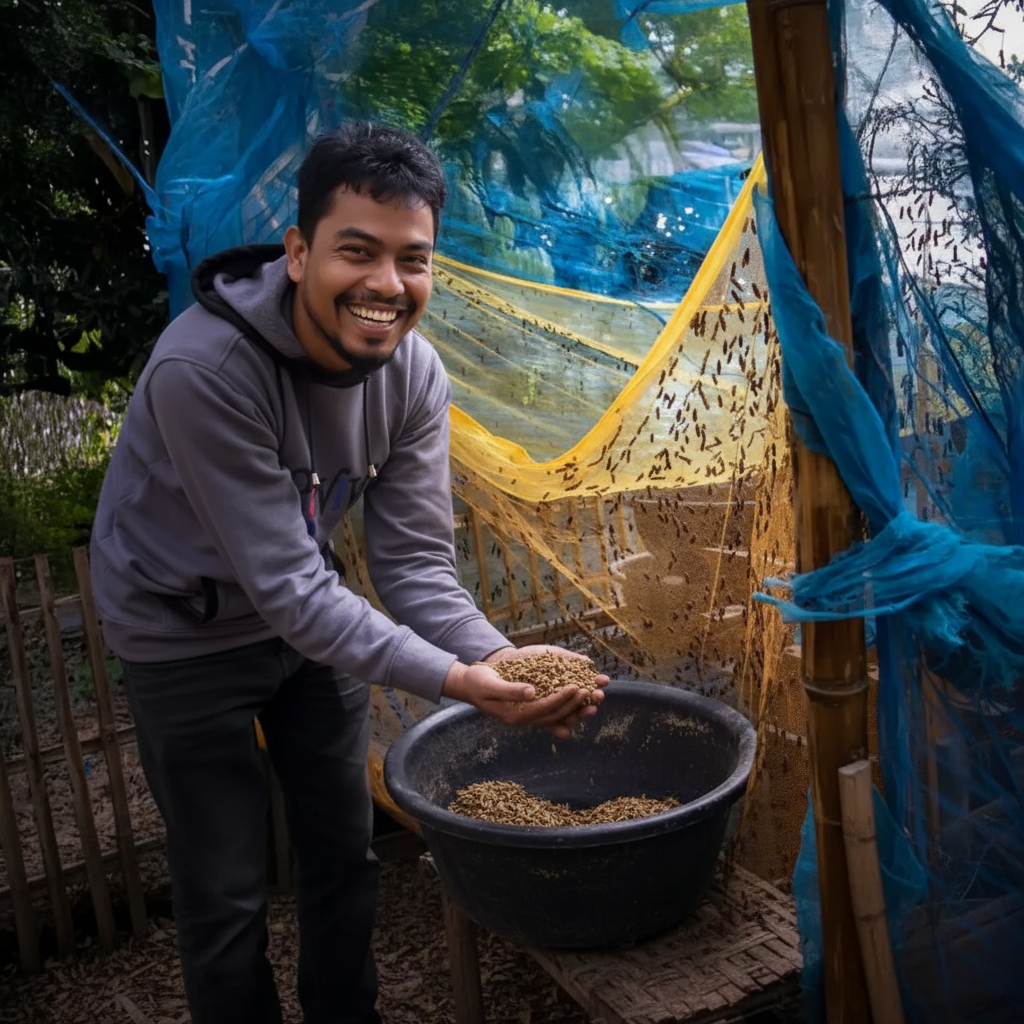
Waste into wealth
Black soldier fly farming works on a surprisingly simple cycle. Eggs hatch into larvae, which feed on organic waste such as discarded fruits and vegetables. The protein-rich larvae can then be used as nutritious feed for fish, ducks and poultry.
For Shimul, this was more than insect farming. He could turn organic waste into a valuable source of animal feed at a low cost. Producing one kilogram of larvae costs him around BDT 15, while its estimated market value is about BDT 80.
But turning the idea into a viable business required more than enthusiasm. In 2021, Shimul received a BDT 200,000 loan through Program for Community Development (PCD), a Partner Organization of PKSF. Under PKSF’s Rural Microenterprise Transformation Project (RMTP), he also received training and technical assistance that helped him improve production and gradually expand his enterprise. What started as a small venture gradually grew into a thriving business. Shimul has now repaid BDT 27 lakh in loans, including debt from his earlier duck farming venture.
From local to global
Today, Shimul operates five sheds producing around 500 kilograms of BSF larvae every day, worth approximately BDT 40,000. His businesses have also created employment for 17 people. His journey has crossed national borders too. From 2022 to July 2026, Shimul exported BSF pupae, the stage before the flies become adults, to India, Nepal, Bhutan, and Pakistan.What began in an old building in a remote village of Pabna had found its way into international markets.
His business model is now evolving again. Earlier, Shimul sold larvae to fish and animal feed businesses. Today, he uses his entire larvae production in his own fish ponds and duck farms. Waste is used to produce larvae, the larvae become feed, and the feed supports other parts of his business. In effect, Shimul is building his own small circular economy. This saves him around BDT 2 lakh a month in feed costs, allowing him to reinvest that value in his other ventures.With growing confidence and experience, he has now established a private limited company, Fly Loop BD, to take his entrepreneurial journey further.
A bigger flight
Shimul now sees a bigger opportunity in the organic waste generated in Bangladesh’s municipalities and city corporations. His dream is to use this waste for large-scale BSF farming, creating both environmental and economic value.
‘I want to turn organic waste from municipalities and city corporations into a valuable resource through black soldier fly farming. This can help keep our cities cleaner, protect the environment and create new economic opportunities. My dream is to expand this model across the country and create employment for at least 2,000 people.’
With support from PKSF’s RMTP project through PCD, Shimul has turned an unconventional venture into a growing enterprise. For the man who was once called crazy for farming flies, perhaps there is no better way to describe his journey. Shimul is now flying high with the black soldier fly.