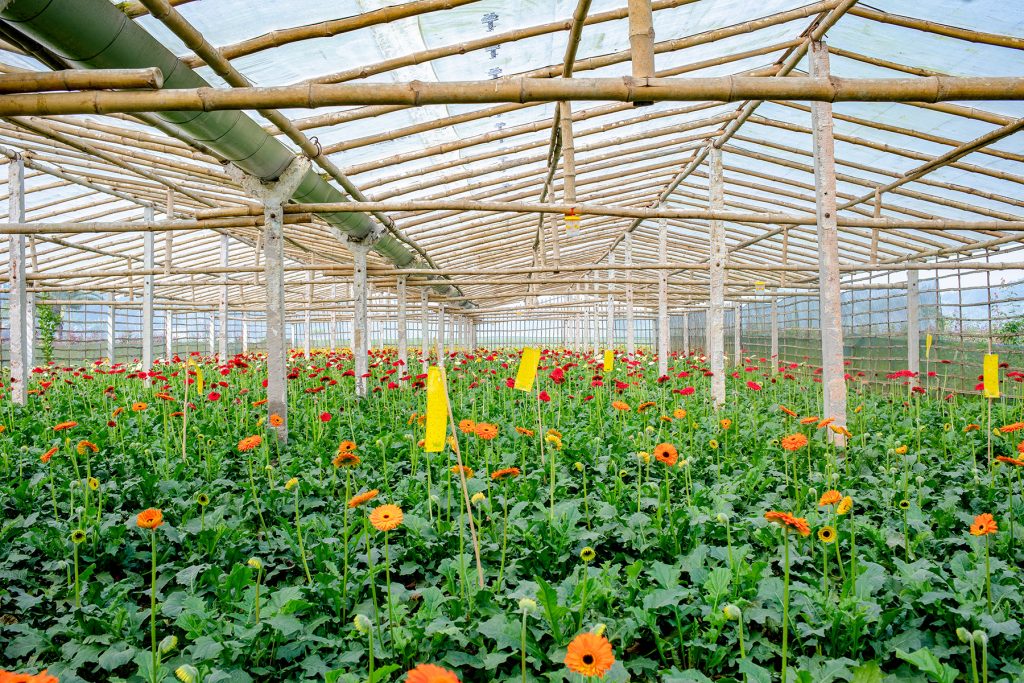
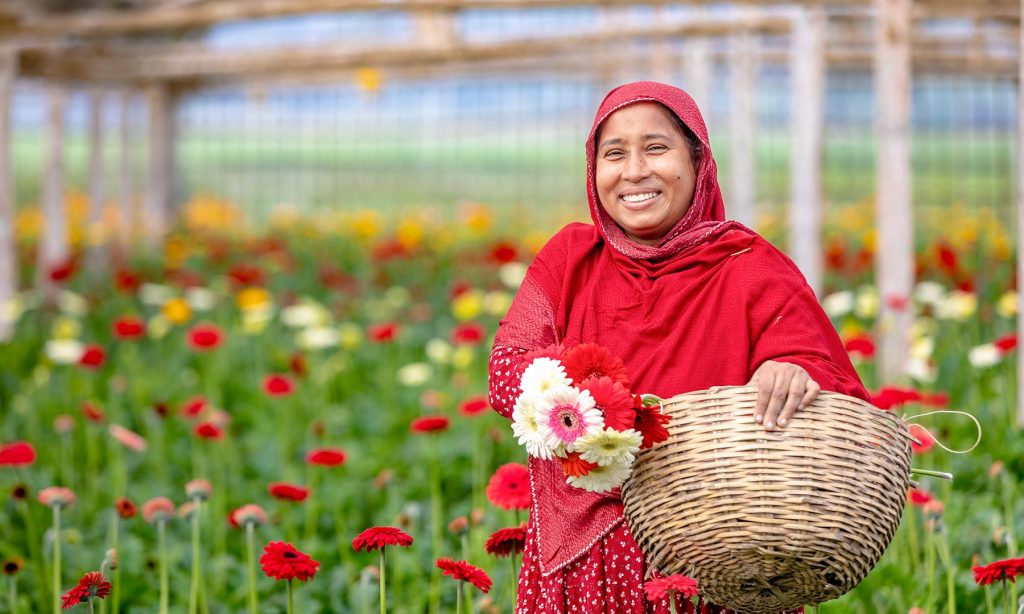
Wherever one looks in Haria village of Jhikargachha upazila in Jashore, vast stretches of colorful flower fields catch the eye. Yet behind this beauty, flower growers face constant worry. Roses, marigolds, gerberas, chrysanthemums, and many other varieties bloom across the fields. However, at the end of each season, calculating profit and loss becomes difficult for flower farmers. Rising prices of chemical fertilizers and pesticides, excessive water use and irrigation costs, weeds accumulating in the fields, and plant waste left after harvesting—all these challenges create uncertainty over Reshma Khatun (30) as they do for other flower farmers.
Reshma recalls, “Even though I cultivated flowers using the methods inherited from my ancestors, it was hard to bring profits home.” Dependence on chemical fertilizers and pesticides increased costs while degrading soil quality. Excessive pesticide use reduced flower quality, and therefore, flowers often failed to fetch fair market prices. Water waste was another major problem. Over-irrigation would increase electricity bills and put pressure on groundwater.
As losses mounted, continuing flower cultivation on her two bighas of land became an uphill battle. Supporting a five-member family, paying labor wages, and facing income uncertainty at the end of every season—altogether the apprehension was always there.
At this critical juncture, PKSF’s SMART project emerged as a ray of hope. With renewed optimism, Reshma joined the project through the Rural Reconstruction Foundation. Though initially hesitant, training gradually changed her mindset. Through the project, she learned about Resource Efficient and Cleaner Production (RECP) practices. The training introduced her to modern flower cultivation methods that reduce costs, minimize waste, and protect the environment. With a loan of BDT 300,000, she began her journey toward eco-friendly flower farming.
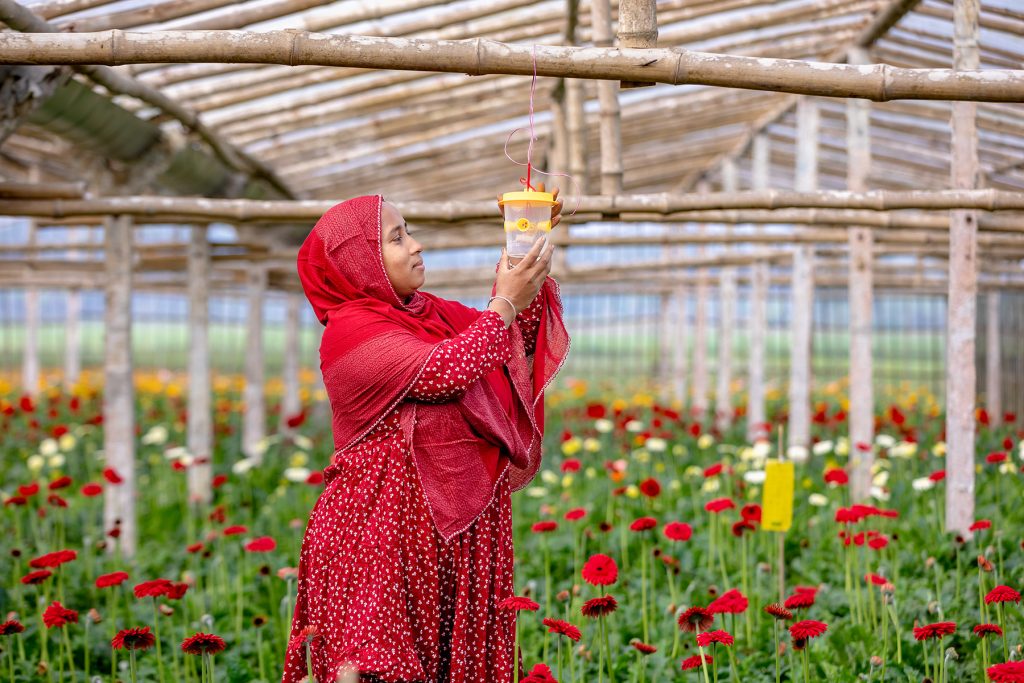
Reshma adopted organic fertilizers and bio-pesticides, which also brought positive health benefits for her and her workers. Instead of chemical sprays, she now uses colored traps and pheromone traps to control pests. This reduced costs, improved flower quality, and extended the shelf-life of flowers. She also abandoned flood irrigation and switched to controlled irrigation using hose pipes, reducing water wastage, lowering electricity bills, and easing pressure on groundwater. Following the project’s guidance, she produces organic compost from flower residues. “What I used to throw away is now food for my land,” Reshma says. “This compost helps the soil retain moisture and increases fertility.”
The results are visible. Her seasonal income has increased from around BDT 175,000 to BDT 225,000—an increase of BDT 50,000 in just one year from two bighas of land. To further modernize her farm, Reshma purchased a mini power tiller, reducing dependence on manual labor and significantly increasing efficiency. Smiling, she says, “Earlier, I needed many workers for cultivation and weeding. Now one worker with a machine can do both.”
Today, the flower fields of Haria village no longer reflect only worry; they show change. Reshma now teaches others about
eco-friendly flower farming and engages community members through environmental club meetings. Inspired by her success, other flower growers have also started adopting sustainable methods.
Overcoming past losses, Reshma is now a successful flower farmer. She has shown that the right guidance, knowledge, training, timely support, and eco-friendly choices can transform a woman’s life, a field, and even the future of a village.
As the soft afternoon light spreads over the fields, rows of marigolds and gerberas sway gently in the breeze. Reshma Khatun stands among her flowers—no sign of exhaustion in her eyes, only quiet hope. She dreams of cultivating diverse flowers, developing her own brand, selling flowers online, and seeing her blooms gain recognition across the country.