
Safe drinking water is becoming increasingly scarce in the coastal belt of Bangladesh, where millions live under the constant threat of salinity intrusion, tidal surges, cyclones, and rising sea levels. In districts like Khulna, Bagerhat, and Satkhira, both surface and groundwater sources have been severely affected, leaving families with few reliable options for drinking water. Women and children often walk long distances to fetch small amounts of safe water, sacrificing their health, time, and security in the process. This daily struggle deepens poverty, undermines well-being, and highlights the urgency of finding sustainable solutions to one of the most pressing climate challenges in the region.
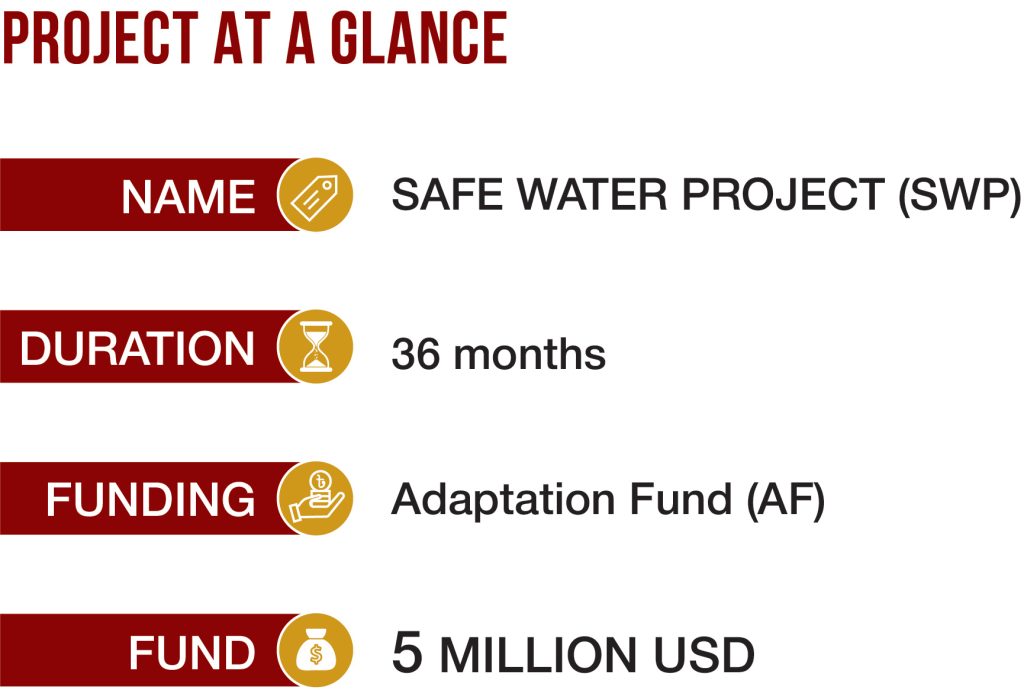
To address this crisis, Palli Karma-Sahayak Foundation (PKSF), with support from the Adaptation Fund, has been implementing the project “Access to Safe Drinking Water for the Climate Vulnerable People in Coastal Areas of Bangladesh through Solar-generated Reverse Osmosis Water Treatment Facilities,” hereinafter referred to as the Safe Water Project (SWP) with a budget of 5 million US dollars.
The project will establish a total of 180 reverse osmosis (RO) based desalination plants and three knowledge hubs in the three coastal districts, providing year-round access to safe and affordable drinking water for 180,000 people. From the environmental sustainability point of view, out of 180 desalination plants, 20 % plants will be operated through solar-generated power. The project will give priority to women and youth, recognizing their critical role in household water management and community resilience. By integrating innovation into water supply systems, the project aims to reduce water-borne diseases, protect public health, and restore dignity to vulnerable households whose lives are directly threatened by climate change.
The project will be operated through locally driven management systems, supported by training, knowledge-sharing hubs, and climate adaptation awareness programs. This innovative and community-led approach not only ensures sustainability of the facilities but also builds local capacity, ownership, and accountability. The plants will be designed with coastal flood-resilient features and adapted to local needs. In an area where only 38 percent of families currently have access to safe drinking water, this initiative will play a transformative role in improving resilience, well-being, and opportunities for coastal communities.
Objectives
The specific objectives of the project are:
- Enhancing the ability of coastal communities to get access to safe drinking water, which are polluting further by the negative impacts of climate change;
- The project aims to ensure water security for coastal families by establishing reverse osmosis water treatment plants;
- To enhance awareness of vulnerable coastal communities on health hazard issues.
Work areas
Sl. | Upazila | District | Division |
1 | Shyamnagar | Satkhira | Khulna |
2 | Assasuni | Satkhira | |
3 | Dacope | Khulna | |
4 | Koyra | Khulna | |
5 | Morrelganj | Bagerhat | |
6 | Sarankhola | Bagerhat |
Key Components
Development of Drinking Water Supply Facilities
- Installation of locally-appropriate Reverse Osmosis (RO) desalination plants.
- Procurement of water testing kits to ensure compliance with national safety standards.
Institutional Support and Capacity Building
- Formation of Water-User Groups to manage plants through participatory approaches.
- Training for community members—especially women and youth—on plant operation, climate change impacts, and water management.
- Establishment of three knowledge hubs in three districts under the project coverage to share best practices and lessons learned.
Project Execution and Operating Entities
The project is being implemented through PKSF’s established network of seven Operating Entities (OEs), with overall coordination, technical guidance, monitoring, and oversight provided by the central Project Management Unit (PMU). The OEs are-
- Community Development Centre (CODEC),
- Dushtha Shasthya Kendra (DSK),
- Eco-Social Development Organization (ESDO),
- Heed Bangladesh,
- Nowabenki Gonomukhi Foundation (NGF),
- Satkhira Unnayan Sangstha (SUS), and
- Unnayan Prochesta,
leveraging their field presence and community-level networks to ensure effective, inclusive, and timely project implementation.
Presently, the Operating Entities (OEs) are actively undertaking the site selection process for the installation of the RO water treatment plants. The selection is being carried out in consultation with local communities and relevant stakeholders, taking into consideration factors such as the availability and quality of source water, community demand, accessibility, population coverage, land availability, site suitability, and climate-related risks. The selected sites will subsequently be assessed and verified against the project’s technical, environmental, and social requirements before final approval for plant installation.
Innovation and Sustainability
The SWP integrates technical, social, and institutional innovations. RO systems will be adapted to local hydro-geological contexts, powered partly by renewable energy, and protected against corrosion and storm damage. Socially, the project promotes equity by prioritizing marginalized groups, including extremely poor household’s dependent on natural resources, female-headed families, and youth. Economically, it fosters entrepreneurship opportunities linked to safe water distribution.
Conclusion
By combining advanced desalination technology with strong community engagement, the SWP offers a scalable model for climate adaptation in coastal Bangladesh. It not only secures safe drinking water for vulnerable populations but also strengthens local institutions, enhances resilience, and contributes to Sustainable Development Goal 6 (clean water and sanitation). The initiative represents both a practical response to urgent water challenges and a long-term investment in climate-resilient development.