PPEPP-EU project brings sustainable changes to the lives and livelihoods of 215,000 extremely poor families
Palli Karma-Sahayak Foundation’s (PKSF) Pathways to Prosperity for Extremely Poor People–European Union (PPEPP-EU) project has made a significant contribution to improving the incomes, assets, nutrition, financial inclusion, and resilience of extremely poor people living in climate-vulnerable and hard-to-reach areas of Bangladesh. Through an integrated approach combining livelihoods, skills development, financing, nutrition and healthcare, women’s empowerment, and climate resilience, the project has significantly reduced extreme poverty among participating households, while the prevalence of stunting among children has declined by more than half.
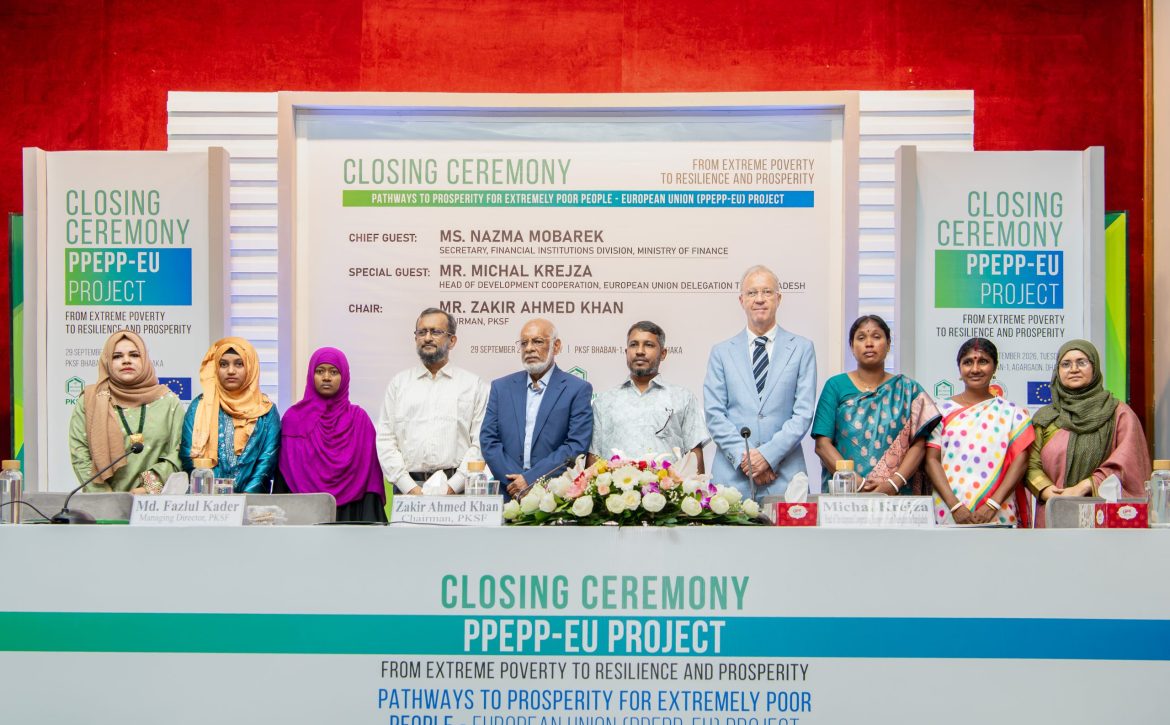
Speakers made these observations at the closing ceremony of the four-year PPEPP-EU project (from October 2022 to September 2026), funded by the European Union.
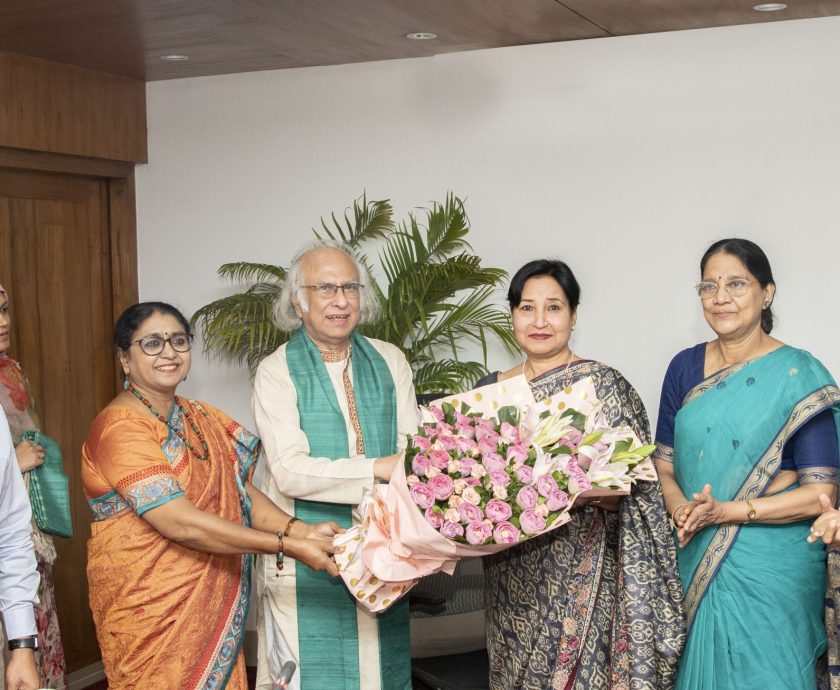
The event held today at PKSF Bhaban in Agargaon, Dhaka, was chaired by PKSF Chairman Zakir Ahmed Khan. Michal Krejza, Head of Development Cooperation of the European Union Delegation to Bangladesh, graced the event as the Special Guest. PKSF Managing Director Md. Fazlul Kader delivered the welcome address, while Salina Sharif, General Manager of PKSF and Project Director of PPEPP-EU, presented an overview of the project. The speech of the Chief Guest, Nazma Mobarek, Secretary, Financial Institutions Division, Ministry of Finance, was read out at the event.
In her speech, Nazma Mobarek said extreme poverty is a multidimensional reality and is not merely a matter of insufficient income or assets. She said, “An important lesson from PPEPP-EU is that the ultimate goal of poverty reduction is not dependence on assistance, but capability and self-reliance. When financial support, skills, market linkages, health and nutrition, social protection, and climate resilience are addressed in an integrated manner, even an extremely poor person can gradually become a producer, entrepreneur, and active participant in the economy.”
Special Guest Michal Krejza highlighted the European Union’s contribution to the project and stressed the importance of building on its achievements and outcomes. He said, “The end of a project’s funding should not mean the end of its impact. The real measure of a project’s success is whether participating families are able to sustain the progress they have made; whether their businesses and livelihoods continue to grow; whether their assets continue to increase; and whether their children are receiving better nutrition than before.”
PKSF Chairman Zakir Ahmed Khan said, “The greatest achievement of PPEPP-EU lies not only in its specific project outcomes, but also in creating opportunities for people to strengthen their capabilities and confidence and move forward on their own path to development.”
He further noted that there had been considerable doubts about whether members of the extremely poor population could become eligible for and effectively use credit. The project, however, has demonstrated that with appropriate support, extremely poor people can develop the capacity to access credit, which can contribute to sustainable poverty reduction in the long term.
He added that although the project has formally concluded, its members will continue to have access to mainstream financial services through the regular programmes of PKSF and its Partner Organizations. The experiences and lessons generated by the project will also inform the design of PKSF’s future programs.
In his welcome address, PKSF Managing Director Md. Fazlul Kader said that over the past four years, more than three-fourths of the extremely poor households targeted by the project had moved above the extreme poverty threshold, with a significant proportion becoming microentrepreneurs. In addition to a grant of EUR 22.81 million from the European Union, approximately Tk 3,217 crore in affordable loans was disbursed among project households through PKSF and its Partner Organizations.
He said, “We have seen that providing assistance to extremely poor people may address their problems temporarily. But when we build their capabilities and create opportunities for them, they can transform their lives. Thousands of families under this project have demonstrated precisely that.”
A presentation on the project revealed that integrated services were provided to approximately 860,000 people from 215,000 extremely poor households through 19 Partner Organizations across 145 unions in 34 upazilas of 12 districts.
The proportion of extremely poor households among project participants declined from 62.7 percent to around 22 percent. The prevalence of stunting among children under five fell from 48 percent to 22.8 percent, which is lower than the national average. The prevalence of wasting also declined from 17 percent to 12.4 percent.
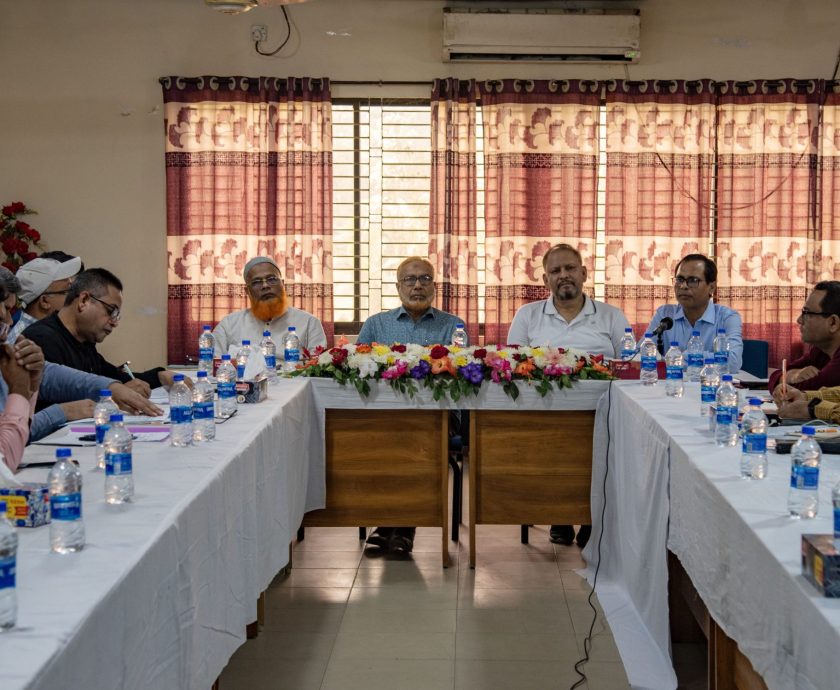
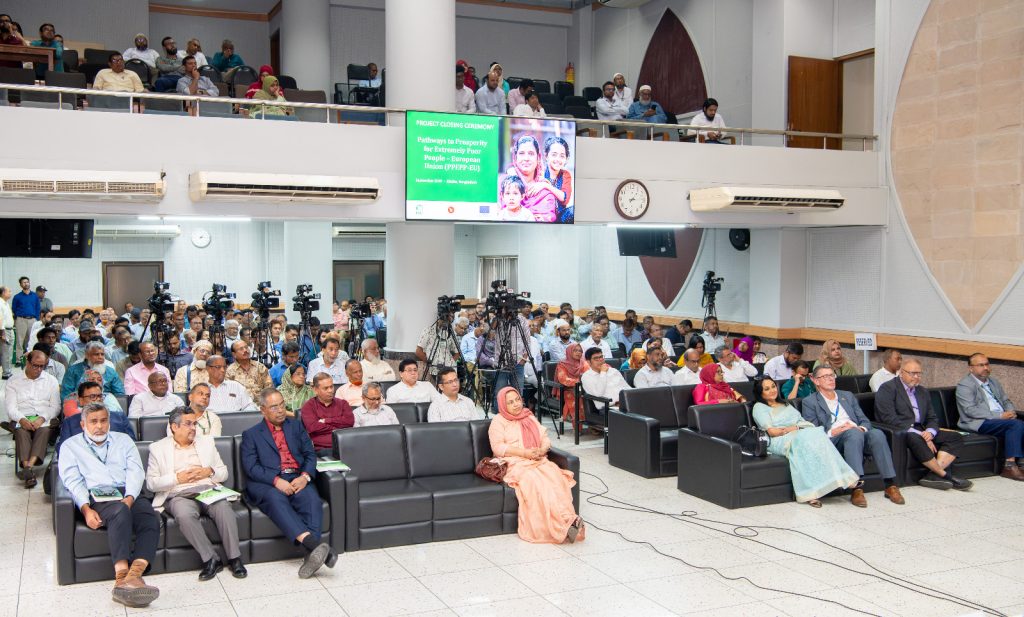
Around 400 participants, including representatives of PKSF, development partner the European Union, various ministries and government departments, PKSF’s Partner Organizations, and other project stakeholders, attended the closing ceremony.