Call for basic overhaul of Bangladesh’s skills development ecosystem
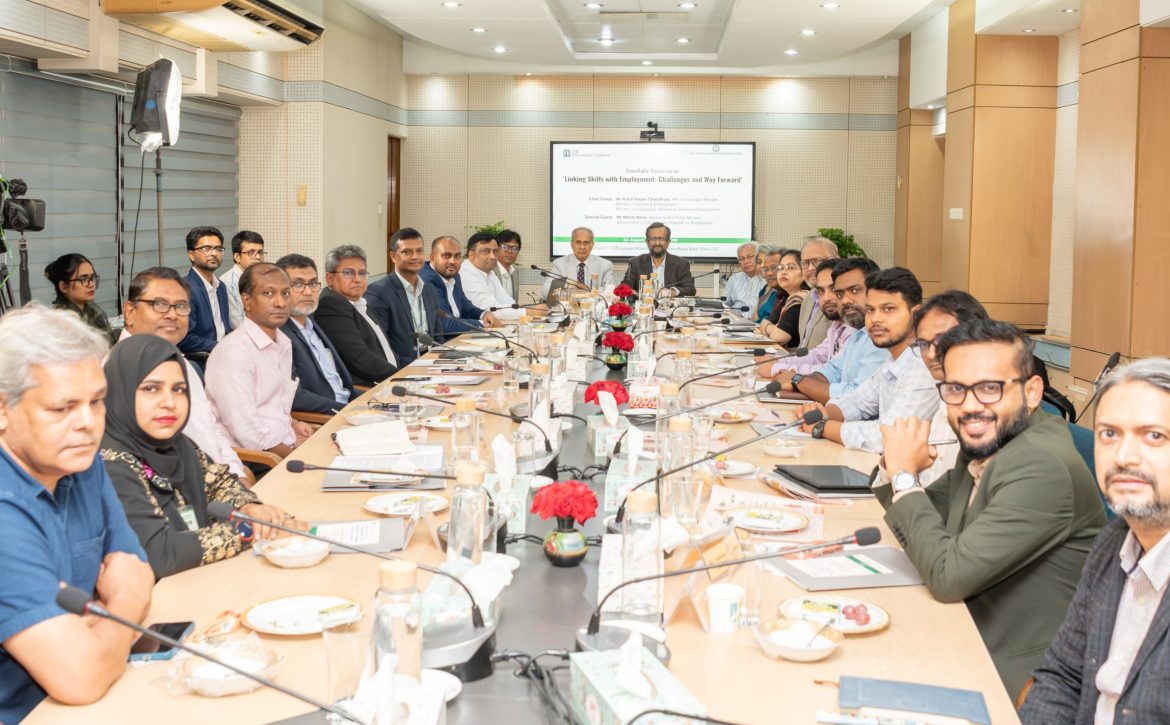
Policymakers, economists, development practitioners and industry experts on Monday called for a fundamental overhaul of Bangladesh’s skills-development ecosystem.
They also observed that a persistent mismatch between education and labour-market demand is preventing the country from fully capitalising on its demographic dividend.
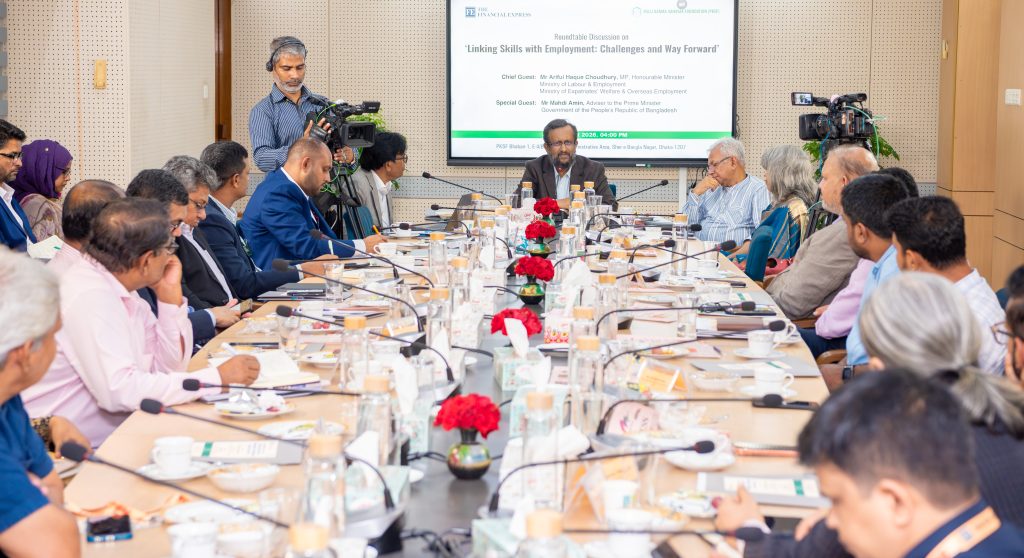
Speaking at a discussion titled “Linking Skills with Employment: Challenges and Way Forward” at PKSF Bhaban in the capital, they stressed the need for closer collaboration among government, academia and industry to ensure that training programmes produce employable graduates and internationally competitive workers.
The Financial Express in association with Palli Karma-Sahayak Foundation (PKSF) organised the event.
Managing Director (MD) of PKSF Md Fazlul Kader said Bangladesh must change its social perception of vocational education, arguing that technical education continues to receive lower social recognition than conventional academic qualifications.
“For better employment opportunities and skills-based education, we must move towards vocational education in line with global practices,” he said.
Mr. Fazlul Kader suggested that the government incentives should be redirected towards industries to encourage them to provide training, develop skilled workers and award recognitions, instead of focusing solely on subsidised loans.
He also highlighted the employment potential in Bangladesh’s informal economy, particularly in agriculture, livestock and value-added micro-enterprises, stressing the need for stronger forward and backward linkages to unlock the growth potential.
Describing modern agriculture as a highly-skilled profession, he noted that an increasing number of educated young people are entering the sector.
Referring to overseas employment, he observed that Bangladeshi migrant workers remained vulnerable because many of them lack formal skills and certification.
“Providing training and producing skilled manpower is essential to protect migrant workers from job losses and exploitation,” he said.
Quazi Moshrur-Ul-Alam, Senior Programme Manager of the PKSF’s RAISE project, said Bangladesh has established a training system, but it is yet to build a complete ecosystem connecting skills with employment.
“The problem is not a lack of jobs, but the absence of an effective linkage between skills and employment,” he said.
Highlighting the impact of practical skills training, a graduate apprentice Ashfakur Rahman shared how a RAISE-supported driving course enabled him to rebuild his family’s livelihood after his father’s death. He now works as a service engineer at Hyundai.
Director General of the Bangladesh Institute of Development Studies (BIDS) Dr A K Enamul Haque said Bangladesh faces a demand-side problem, as the economy fails to generate sufficient opportunities for science graduates and knowledge-based professionals.
“We continue to value clerical qualifications over practical knowledge, while industries lack incentives to innovate and absorb skilled graduates,” he said.
Professor Sayema Haque Bidisha of the Department of Economics at the University of Dhaka said Bangladesh needs to address the persistent mismatch between the supply of graduates and industry demand.
She said both domestic and international labour market requirements should be carefully assessed so that skills development programmes reflect actual market demand.
“This requires coordinated efforts among academia, industries and policymakers,” she added.
ATM Mahbubul Karim, Project Director and Joint Secretary of the Wage Earners’ Welfare Board (WEWB), underscored the importance of strengthening the capacity of recruitment agencies to facilitate sustainable overseas employment.
The World Bank Task Team Leader Aneeka Rahman also called for an integrated skills ecosystem in which curricula and training delivery are directly aligned with labour market requirements.
The FE News Editor Anisur Rahman stressed the importance of strengthening foundational education, arguing that basic education and skills development should be linked to reduce school dropout rates and prepare students for vocational training.
Md Ashfaqur Rahman Khan of the International Organization for Migration (IOM) Bangladesh said the country lacks reliable labour market data to determine future demand for different occupations, calling for institutional reforms instead of fragmented project-based interventions.
Executive Director of UCEP Bangladesh Dr Md Abdul Karim said Bangladesh’s education system remains heavily skewed towards general education, unlike developed countries where technical graduates dominate.
“This imbalance leaves many graduates unemployed while industries struggle to recruit skilled workers,” he noted.
Executive Director of ESDO Dr Md Shahid Uz Zaman stressed the need for addressing the psychosocial challenges faced by marginalised youth alongside technical training, proposing the creation of “job banks” to better support employment transitions.
Dr Md Towfiqul Islam, member, Governing Body of PKSF suggested introduction of foreign languages such as Japanese and Arabic from the primary level to improve overseas employment prospects, saying language proficiency could significantly enhance earning potential.
Joint Secretary of the Ministry of Finance Kamrul Hoque Maruf stressed the need for anticipating future labour market requirements in emerging fields such as machine learning and industrial automation, supported by tracer studies to evaluate employment outcomes.
Deputy Managing Director of PKSF Md Mashiar Rahman said successful training initiatives should be expanded through enterprise financing models, enabling experienced entrepreneurs to train additional workers and generate large-scale employment.
Towhidur Rahman of the International Labour Organization (ILO) warned that nearly 90 per cent of Bangladeshi migrant workers still lack internationally recognised skill certificates, weakening their bargaining power and exposing them to exploitation abroad.
Additional Secretary Mohammed Walid Hossain concluded the discussion by highlighting the need to embrace emerging technologies, including 3D printing and industrial automation, through a practical, industry-oriented approach to skills development.
Moderated by Shiabur Rahman Shihab, FE online head, the discussion was attended by representatives from government agencies, development partners, academia, international organisations and the private sector, who agreed that stronger industry participation and demand-driven training are essential to creating sustainable employment and enhancing Bangladesh’s global competitiveness.